Eighth schedule means independent identity of a language. What will remain of Hindi if its key dialects are recognized as separate languages? The only reason Hindi has its status as official language is that it has the highest number of speakers
Linguistic Chauvinism: The True Face of the Language of National Integration
The other India speaks and demands #GoIMakeMyLanguageOfficial !
The Centre being a collective Union and a representative of all of India should either promote all languages or make the promotion of all languages including Hindi the responsibility of states where they are native. Spending all taxpayers money on promoting just one region’s language is grossly unjust and must stop immediately.
Let Us Talk about a Forgotten Private Member Bill – the Official Languages Bill 2012
- If for 45 years, not a single Private Member bill was accepted, then is there a point in having a provision to move a Private Member bill at all?
- When the rights of a few transgenders are taken seriously (rightly so), why is that language rights of non-Hindi speakers, who form the majority of India, are considered fit to be ignored?
- Can India call itself a democracy, when the Union government so openly and brazenly discriminates between Hindi and non-Hindi languages?
- Success of any democracy lies in bridging the gap between the system and the people, and the biggest tool to achieve this goal is to use people’s languages in administration. Can India’s democracy succeed by simply ignoring the presence of all non-Hindi languages?
Indian cinema = Hindi cinema?
Suprising charter this...
While at the outset, a charter to project Indian cinema on screens across the world sounds good and of huge value to movies of all Indian languages, what the IIFA has been actually doing brings big surprise. In one of its advertisements this is what IIFA boasts itself of having achieved...
Wherever IIFA has left its mark, it has promoted the business of Indian Cinema and provided it an impetus. The sale of tickets of Hindi cinema grew by thirty five percent in the UK in the six months after IIFA. In South Africa, Hindi films moved from matinee shows on weekends to mainline theatres and now there are competing distribution chains vying for the rights to exhibit Hindi films across Africa.
The difference needs to be clear!
The IIFA talks about movies from India in the same tune as it talks about Hindi films made in India as though knowing no difference between the two. Well, the real difference, apparently, is not known to the academy. All it has done since inception in 2000 is advertise Hindi film industry across the globe with the label of Indian film industry, thus sending very very false signals about the Indian film industry across the world. This has also led to a noticeably biased growth taking place in the Hindi film industry and a noticeable decline in the worldwide presence of movies of other Indian languages, including movies from the Kannada film industry.
Made in India, not Hindi!
With all these biased stands towads the Hindi film industry, and calling it the Indian film industry, they even boast of having a very qualified advisory panel consisting of not a single character from non-Hindi film industry. What a pity, this board is advising on labeling Hindi films as sole candidates for the Made in India label.
If the stand of IIFA was so clear to project, showcase and promote only Hindi film industry, it would have been apt to call it International Hindi Film Academy (IHFA). Developments under IIFA have certainly benefited the Hindi cinema, but have done little to support their claims of improving the Indian film industry. Instead what is expected of such an academy is a system to enable uniform upbringing and showcasing of film industries of all Indian languages in an unbiased manner. Such academies should eventually pave the way for making Indian entertainment truly representative of the whole of India, which is a union of linguistic states.
BIAL: the forgotten shame

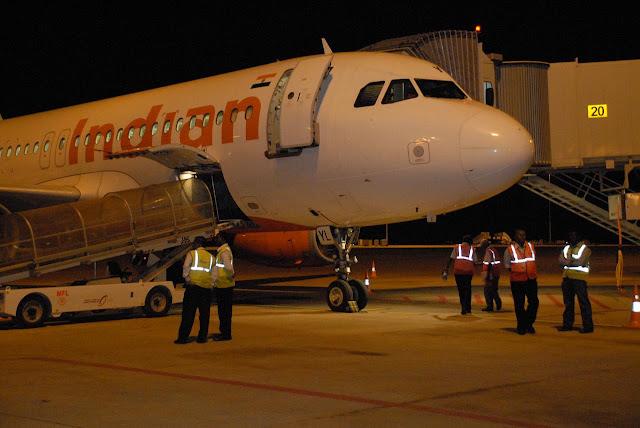
We are being made to forget that Kannadigas were promised jobs in return for land and cheated in broad daylight. We are being made to forget that the airport continues to stink of Hindi and flushes Kannada - the language of the very land on which the airport stands - down microprocessor-controlled urinals. We are being made to forget how Hampi and the rest of Karnataka's proud history and culture have been considered too inferior for the ambience of our own airport. We are being made to forget how workers of the Karnataka Rakshana Vedike - who were peacefully demonstrating against the injustice done to Kannadigas have been made to fill jails like criminals. Who are the real criminals? Those who ask for their own rights, or those who suppress others' rights like colonial masters?
Yes, all the hue and cry about material comforts at the new airport has buried the fact that the Kannadiga spirit together with everything that unites Kannadigas and makes us one has been given a death blow. Everything that we were, are, and want to be has been gloriously neglected. We are being told that what matters is what others were, are, and want to be.
Won't we get up? Won't we scratch the shining walls of the new airport and stand up for fellow Kannadigas? Won't we? Won't we? Won't we?
Also read: Airport: what ought to be and what shall be, Bengaluru should learn from Beijing
Karnataka's "linguistic inferiority complex" must go
PUROHITA writes from Singapore: Just as the effect of hundreds of years of environment can be seen in the bark of a tree, the effect of hundreds of years of history can be seen in the linguistic inferiority complex that prevails in Karnataka today. I use the term linguistic inferiority complex (LIC) to denote inferiority complex relating to one’s own language, its utility, its boundaries and its importance. The disastrous effects of this inferiority complex can be seen in our education system, our society, industry, and in general just about everywhere. LIC is so second nature to the so-called "thinkers" of Karnataka today that even its existence is not acknowledged by them. LIC in Karnataka is made up of the following four unwritten linguistic inferiority complexes, not one of them scientific or democratic or supported by commonsense or fact:
- Kannada can be used only for "simple conversations and light stuff like poetry, drama and other non-scientific things"
- English is the best language for "conversations between intelligent people; definitely the language for any scientific topic"
- Samskruta is the only language for anything even slightly spiritual
- Hindi is more important than Kannada in India
The first inferiority complex can be traced to India’s colonial past. The British who opened English schools instead of Kannada and Samskruta schools sowed the seed of linguistic inferiority complex. School students used to get punished for speaking in Kannada (this is seen even today in most of Bengalooru schools) and rewarded for every small achievement in English. With this a sense of achievement got attached to English and a sense of non-achievement to Kannada. Kannada came to be slowly regarded as a language fit only for simple conversations and light stuff like poetry, drama and other non-scientific things – because the British simply didn’t let anything other than that to go on in Kannada. They truly didn’t think Kannada was fit for anything at all. Even after independence and consequent formation of linguistic states, Kannada is not fully implemented in administration, education or industry.
Since the British introduced English as the panacea in the atmosphere of inferiority which they themselves created, it slowly replaced Kannada as the language for conversations between intelligent people; definitely the language for any scientific topic. The English education system was nothing but an engine producing more and more people with this fatal inferiority complex, fit to serve the British crown. Those who came out of the system took pride in hating Kannada, making fun of Kannada and being able to speak English. The flawed arguments that English (as opposed to knowledge) is the strength based on which we can win global markets today, that English is the language of science and technology, stem from this very same inferiority complex continuing to pollute a Kannadiga’s blood. Although examples exist of countries like Japan, Israel, France, etc., which have all their systems in the language of the land, a Kannadiga is blind to this because of this second inferiority complex.
Samskruta enjoys a special place in Karnataka because of the huge corpus of spiritual literature which exists in it (not that we read or understand it). Almost every spiritual thinker of India – real or fake – has resorted to Samskruta as the language for his spiritual literature. This has been disastrous from the point of view of dissemination of true spiritual thinking among Kannadigas. Even today, most of Karnataka remains spiritually challenged because of this single mistake. Kannadigas have come to believe that spiritual literature cannot exist in Kannada, that our Gods understand only Samskruta! We are so spiritually blind and so mesmerized by Samskruta that we think anything and everything written in Samskruta is divine, that even the language and its grammar are divine and worth imitating in Kannada. It’s a pity that even our grammarians have bought into the flawed theory that Kannada – a Dravidian language – is derived from Samskruta, a theory proven totally wrong by linguists all over the world. This is our third inferiority complex.
The issue of Hindi (at best a budding language when it comes to age or achievement compared to Kannada) is more recent but reminiscent of British imperialism. Although there is no constitutional provision granting Hindi the status of "National language", Karnataka has been made to believe so. Hindi is merely – but undemocratically – the only official language of the Indian Union, but schoolchildren in Karnataka are taught the blatant lie that Hindi is the National language of India. The central government invests hundreds of crores of rupees every year to impose Hindi on Kannadigas in education and central government institutions, even banks, using every medium possible. In the name of urbanization, entertainment media has very tactfully imposed Hindi on Kannadigas and made us believe that real entertainment can exist only in Hindi. Slowly, therefore, the suicidal feeling that Kannada is "not enough" to get on to Mainstream India has crept into a Kannadiga’s thinking. Kannadigas have come to believe that Hindi is a more important language than their mother-tongue in India. This is our fourth inferiority complex.
Linguistic inferiority complex is draining the life-blood of Kannadigas, turning us into inferior individuals building an inferior Karnataka. It has already brought about a class divide in Karnataka. The "higher class" slights Kannada and Karnataka, experiences physical pain living in Karnataka, is devoid of self-respect, cannot compete with westerners in true intelligence because of having to use a foreign language, and is waiting in long visa queues to escape from reality. The "lower class" – which cannot slight Kannada and Karnataka – is removed from education, science and technology (due to English) and commerce (due to English/Hindi). Both classes are removed from spirituality (due to Samskruta). It is clear that linguistic inferiority complex must be rooted out from the mind of every Kannadiga if at all we wish to progress. There is no option but to think of ways in which Kannada can completely replace English in education, science and technology, and Samskruta in spirituality and religion. Hindi together with the baggage of lies must be removed from school syllabi and the constitutional priority of Kannada in Karnataka must instead be taught; Kannada must replace it in central government offices, banks and commercial institutions.
Serve and 'Wah'li in Kannada!
Business - way to go!
Talking of business and its ways to find success in a market like ours, it is but affirmative for the businessmen to understand and keep high the spirit of this market - its cultural footprint. The strong interleaving of language with the culture of a society in general leads to this understanding that success of a business in a market is all about how well the business understands and aligns to the cultural and linguistic vein of the market. Failing on these counts could be detrimental to any kind of business, apart from leaving a trace of violation of the rights that rest with the customer.
Kannada in Karnataka means business
Business with a Kannadiga, especially when inside Karnataka, cannot happen without the involvement of Kannada language in every part of its activity - be it on the customer interaction front involving talking and liaisoning with customers, or marketing of products, or in the packaging and delivery of goods to the customer's end. The usage of any language other than Kannada in business with a Kannadiga is not only an unfair practice by the businessman, because by doing so the businessman has kept the customer in darkness about important product related information, but also a display of lack of business acumen.
Any kind of interaction with a customer is proved to be most effective (in a broad sense) when it happens in the language of the land - that is Kannada on Karnataka soil. The emergence of Radio Mirchi in Bengalooru at the top (leaving Radio City behind) after they resorted to 100% Kannada music is an apt benchmark for this.
Looking around
An urge to think out of the box, retain the common sense and conduct business in Kannada is all that is required to shine and make hay in business on Karnataka soil.
Bengaluru should learn from Beijing
At 29,000m long, terminal 3 looks like a Chinese Dragon lying at the northeastern corner of Beijing. The ball that the dragon is playing with is the parking lot and the subway terminal. The dragon's head, body and tail are the main buildings of the terminal.
[...]
The interior decorations feature traditional Chinese characters.
[...]
Passengers here can take leisurely strolls through Chinese gardens.
One asks how much of Kannada culture our Bengaluru International Aiport will be displaying. Being what we are, we shouldn't be surprised if it is built after the Taj Mahal, that hackneyed monument which 99% Kannadigas have never seen or been to, and whose patron King (together with his dynasty and race) hadn't even heard of the Kannada language, and who at best would have looked at Kannadigas with the eyes of a predatory bird, if at all.
According to CNN Beijing, Chinese engineers want the new terminal to be world class, but with recognizably Chinese features.
CHEN GUOXING of the Beijing Capital International Airport Co. Ltd. proudly declares:
I want every passenger to be able to tell once they arrive that they are in Beijing, even without seeing a sign that reads Beijing.Ah! now to our own Bengaluru International Airport. This will perhaps be world class too, but what about the "recognizably ___________ features" ? What will fill the blank? Do you think it's gonna be Kannada? Do you think it should be Kannada? We've already argued how what shall be is gonna be divorced from what ought to be, didn't we? Passengers to our Bengaluru International Airport will be able to tell once they arrive that they are in New Delhi!
Yeah, you bet our airport it's gonna be full of English and Hindi, with Kannada not even featuring inside the toilets! We had reported in ENGURU how a union minister visited the airport site a few months ago and pulled the curtains down on plans of making the interiors reflect Kannada culture. His point was that that takes away the international sheen. Takes away the sheen my foot! All it would have taken away is the ignorance of that minister and servile fools who still can't get over the feeling that Kannada and Kannada culture is non-International. All it would have taken away is the illogical, ill-begotten, ill-conceived, undemocratic Hindification of India at the cost of Kannada language and culture.
When will we grow up? When will we stop feeling small? There is no external trigger necessary or sufficient. It has to come from inside. We need to start feeling from inside that we Kannadigas have got balls too. Yeah, international balls.
Airport: what ought to be and what shall be

And here are typical signs inside the Munich Airport which hasn't found it embarrassing to use the local language - German - on anything printed:

The question now is - what ought to be the status of Kannada in the Bengaluru International Airport? No points for answering this one: "Similar". But what shall be is a totally different ballgame.
What ought to be
BIAL should adopt measures to make all such services available in Kannada as it would like to offer its customers. Be it parking tickets, or flight boarding passes, media inside the airport - printed or visual, entertainment at the airport, and even inside the flights, or announcements made in the airport premises - each one of these should predominantly be offered first in Kannada. Every service in the airport should be available in Kannada. The airport's webpage should also be completely in Kannada.
Obviously, we don't mean English should be nowhere. English should be the only other second language used inside the airport. No other language (e.g. Zulu, Hindi, Sinhalese, Afrikaans, Punjabi, Tamil) can have a place in the Bengaluru International Airport which is not enjoyed by, for e.g., French in the Munich Airport.
Any guesses on what shall be?
Remember, we live in a special country where French (Hindi) has constitutional and extra-constitutional rights to take the place of German (Kannada) in the Munich (Bengaluru) Airport. In our special country, French (Hindi) is not only declared as the official language but is taught as the National Language of Germany (Karnataka). It is only in India that people shall land into the Munich (Bengaluru) Airport thinking the Eiffel Tower (Taj Mahal) is a minute's walk and that the Oktoberfest (Hampi Utsava) is breathing its last in another country whose people are becoming evolutionarily extinct. It is only in India that airports can completely warp the past, present and future of the people and language of the very soil on which they are hosted and make it seem like a desert of under-achievement. It is only in India that the language of the land can be openly treated like the language of an inferior tribe. It is only in India that a whole linguistic people can be deemed constitutionally inadequate for not speaking a language foreign to their tongue.
Ah! What shall be is anybody's guess. Do we have any of those true men left who stand by what ought to be and stop not until what threatens to shall be shall not be?
Mumbai in question
You can fool all the people some of the time, and some of the people all the time, but you cannot fool all the people all the time.There was a time when all non-Hindi speakers were fooled. Even to this date, many of them remain fooled. But we now have proof that you can't fool all the non-Hindi speakers all the time: they hit back.
No doubt the recent events are unlawful and not worth writing home about. It's also being argued that the need for Raj Thackeray to survive in the world of politics is behind them. However, is that all there is to all this? Is this just about a set of barbarians attacking innocent hawkers on the street driven by the political ambitions of Raj Thackeray? Nobody seems to go beyond this. Nobody seems to even bring to memory the slow but certain wiping off of the Marathis and their language from Mumbai. The pain of the Marathi people is no longer questioned today; indeed, that pain has become an unwritten law.
The sad state of Marathis in Mumbai
While the Constitution of India accords the status of "official language of the union" to Hindi, its uncontrolled and unwarranted imposition on innocent speakers of the language of the land outside the walls of central government offices is perhaps on an all-India high in Mumbai. Over time, the Marathis have been made to give up their own identity as speakers of a separate tongue called Marathi which is the lawful heir to the throne at Mumbai. Instead, Hindi has usurped that throne.
Bollywood itself - the Hollywood of erstwhile Bombay - has no traces of the Marathi language left in it. The word Bollywood which should ideally denote the Marathi film industry is famous world over as the Hindi film industry. Hindi imposition seems to have worked such magic on the Marathi people that they seem to have given up hope of elevating their mother tongue to be the entertainment language of choice.
Due to all this, the Marathis see that their language has been thrown into the dustbin. They see that their own people are not getting jobs in Mumbai. They see that the interests of their own people are neglected. While Mumbai is no doubt providing employment to millions of people, they are forced to ask -- "what's in it for us, the hosts?". The answer manifests itself as an undisclosed pain in the hearts of millions of Marathis.
Obviously, this can't go on for ever. No people desirous of furthering their tribe can afford to yield to the rhetoric that they, and they alone need to be altruistic in an environment of reckless predators, however much the rhetoric be sugarcoated and temporarily fooling.
Flawed rhetoric
There is no dearth of flawed rhetoric about all these events being "against the spirit of India", "parochial" and "politically motivated".
These events are admittedly unlawful and leave a bad taste in the mouth. However, to call these as "against the spirit of India" is going overboard. In truth, these events are against the spirit of only that India into whose definition one permits an undemocratically higher status to one language and its speakers from North India called Hindi, an India which is stuck up with the task of synthesizing unity by way of Hindification, an India struggling to iron out diversity as opposed to celebrating it. It is Hindification which is against the spirit of India. These events are merely unlawful and uncivil.
The correct India is that in which unity is practiced by way of upholding diversity as opposed to destroying it. The correct India is that in which subscribers to the Federation of States are looked at as equals as opposed to unequals . The correct India is that in which the subscribing linguistic states have a fair representation in Delhi as opposed to unfair. The correct India is that in which the subscribing linguistic states have the right and duty to protect and develop their own languages, cultures and peoples. The correct India cannot impose Hindi all over India. The correct India cannot look at the people of any language, their culture and their rights with abandon.
Those who think all this is "parochial" must first understand that the scope of events pertaining to the sustenance of any linguistic populace is far from being narrow. This particular time, it is about a People called the Marathis -- close to 65 million people! That's not a few people, mind you, and the protection of the rights of millions of people of one tongue is not parochialism. If this were parochialism, our cries as a united India in the community of nations in the world is parochialism too. Why shouldn't one call as parochialism India's need to protect its borders from Pakistan? Isn't the protection of India from Pakistan too "narrow in scope"?
Now, all those who are sticking to the single-point rhetoric that the recent events are "politically motivated" have also the obligation to ask themselves as to what it was which has motivated the imposition of Hindi on Marathis, what it was which has motivated the uncontrolled migration of Hindiwallas to Mumbai to the total detriment of the Marathis, what it was which has motivated the feeling that Marathi is the language of a lesser God inside Maharashtra itself! Wasn't that motivation also "political"? It is utter foolishness, nay hypocrisy, to expect a spiritual response complete with fasts-unto-death from people at the receiving end of decades of neglect.
Tailpiece
Thus, while the sad events in Mumbai this week appear on the surface to be "parochialism" or simply "politics", one just needs to scratch the surface to understand that they are the bitter fruit of decades after decades of disrespect towards the Marathis, their language and their land. We need to understand the reasons for such outbursts without sacrificing reason to hackneyed rhetoric, set right historical wrongs and march forward. That is the right path for the progress of every Indian state, and thereby of India.